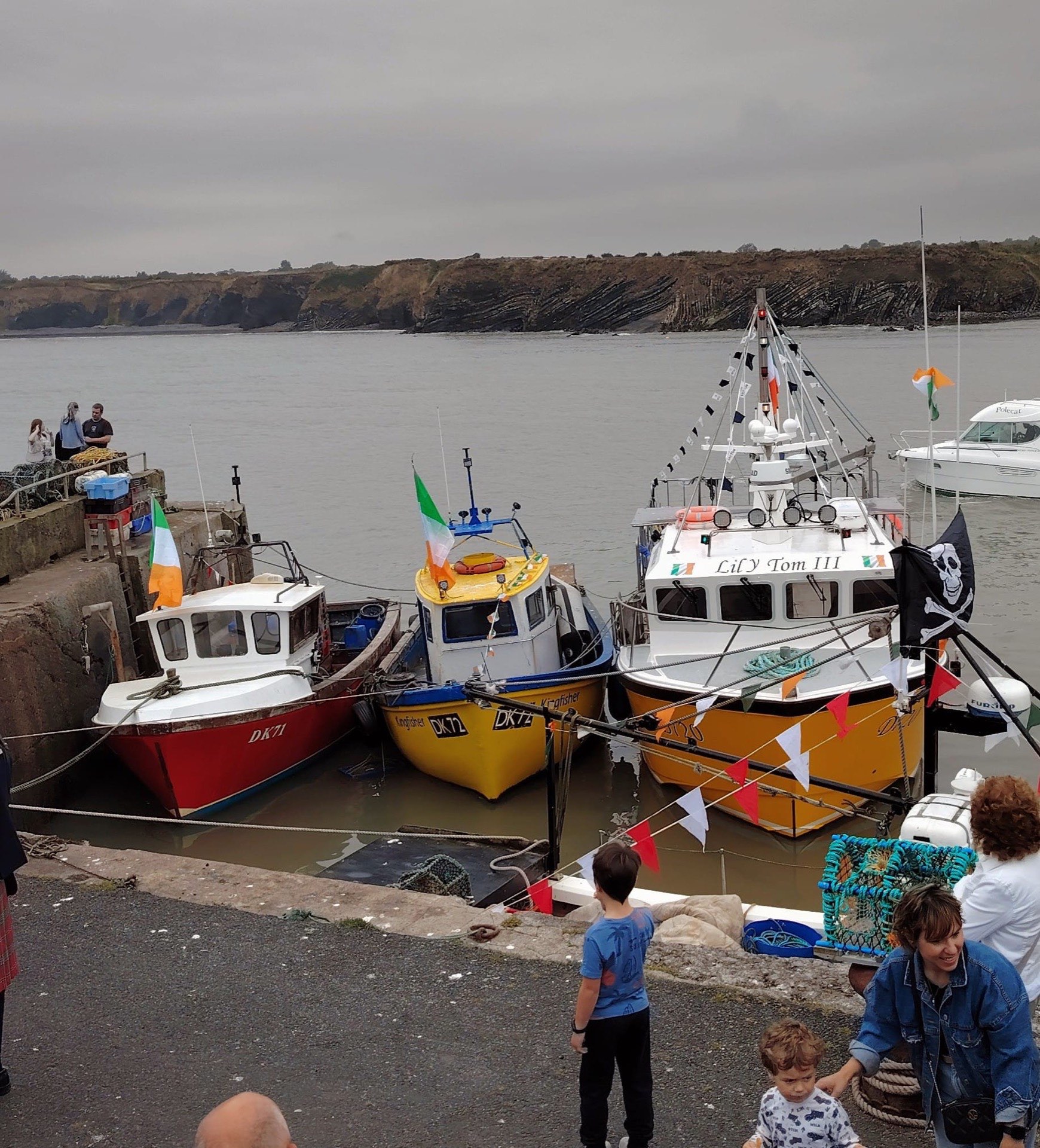
The picturesque fishing village of Loughshinny (population around 800) lies midway between the towns of Rush and Skerries in North Fingal. Its little bay, harbour and safe sandy beach make it a favourite picnic spot in summer.
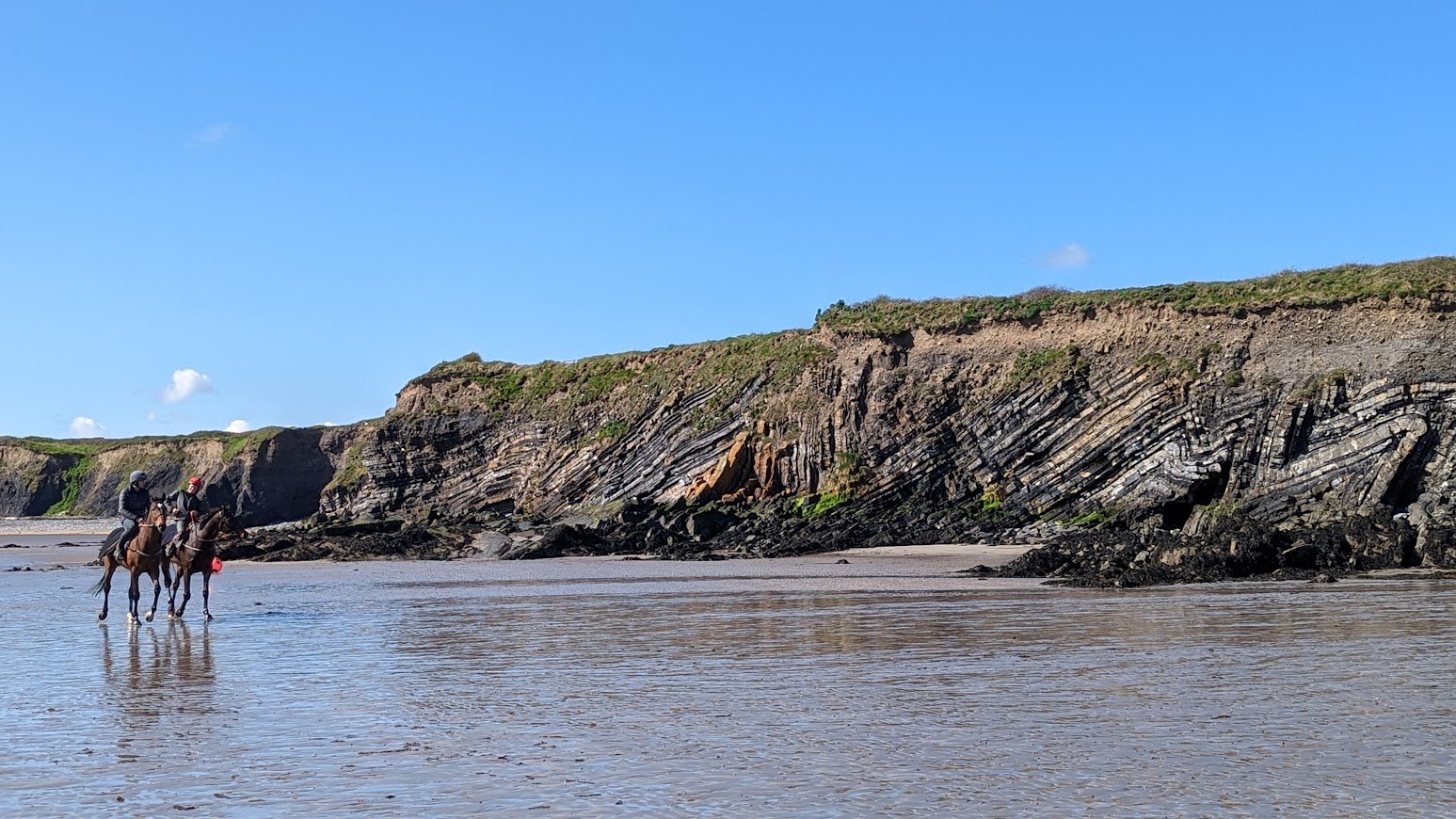
Cliffs, fossils and a Bronze Age fort
On the south side of the bay, the angular folds of the layered limestone and shale cliffs, some 20 metres high, are of great interest to geologists. The fossils in the rocks are some 325 million years old, and the upper few metres of the cliff are made up of boulder clay deposited at the end of the Ice Age.
Above the cliffs, on the headland of Drumanagh, are the remains of the largest promontory fort in Ireland. It dates from the late Bronze or early Iron Age, and its earthen ramparts are still intact right across the western side of the headland.
There has been some speculation and debate as to whether the Romans visited here, but local tradition has it that this was the fort of the trader Forgal Managh, father of Emer, who became the wife of the great Ulster hero Cúchulainn. The courtship of Emer and Cúchulainn is well documented in “The Táin”, as is the battle at Forgal’s fort, when Cúchulainn vaulted over the ramparts with the aid of his javelin.
Vikings and Normans
The Vikings were the next to settle in this part of Fingal. Having established themselves on Lambay Island in 795, they raided the monasteries on Holmpatrick Island, off Skerries, and at Lusk. The small, secluded harbour at Loughshinny must have seen many a longboat pulled up onto the shore. They stayed for 400 years, intermarried with the local people and left their name on the area: Fingal, “the land of the fair-haired strangers”. In Loughshinny, the little clump of land close to the harbour is still known as “The Greenhouse”, probably from the Viking custom of putting sods of earth on the roofs of their houses. Some Viking surnames still survive in the area.
Next came the Normans, and the lands at Loughshinny became the property of the De La Hayde family, who came from Stodham in Bedfordshire, having settled there from Normandy shortly after the conquest by William the Conqueror. In 1220 Cosmo De La Hayde was the last Abbot of Holmpatrick Abbey before it was transferred to the mainland in 1224. The family grew in importance until, by 1533, under Henry VIII, Richard De La Hayde of Loughshinny was Chief Justice in Ireland. Richard is buried with his wife Eleanor in Holmpatrick graveyard in Skerries, where his tombstone, bearing the De La Hayde coat of arms, can still be seen.
Copper mines and the Martello tower
After the 1641 rebellion and the Cromwellian campaign, the De La Haydes lost all their property, and the lands at Loughshinny were granted to one John Aston, Gentleman, in 1659. By the 1770s, when Luke Dempsey was proprietor, the Loughshinny copper mines were open, and experienced miners were brought over from Germany and Belgium. The mines thrived for a time because of the demand for copper for ammunition, but after the Napoleonic wars the price of copper fell, the mines became uneconomic, and they closed in 1812.
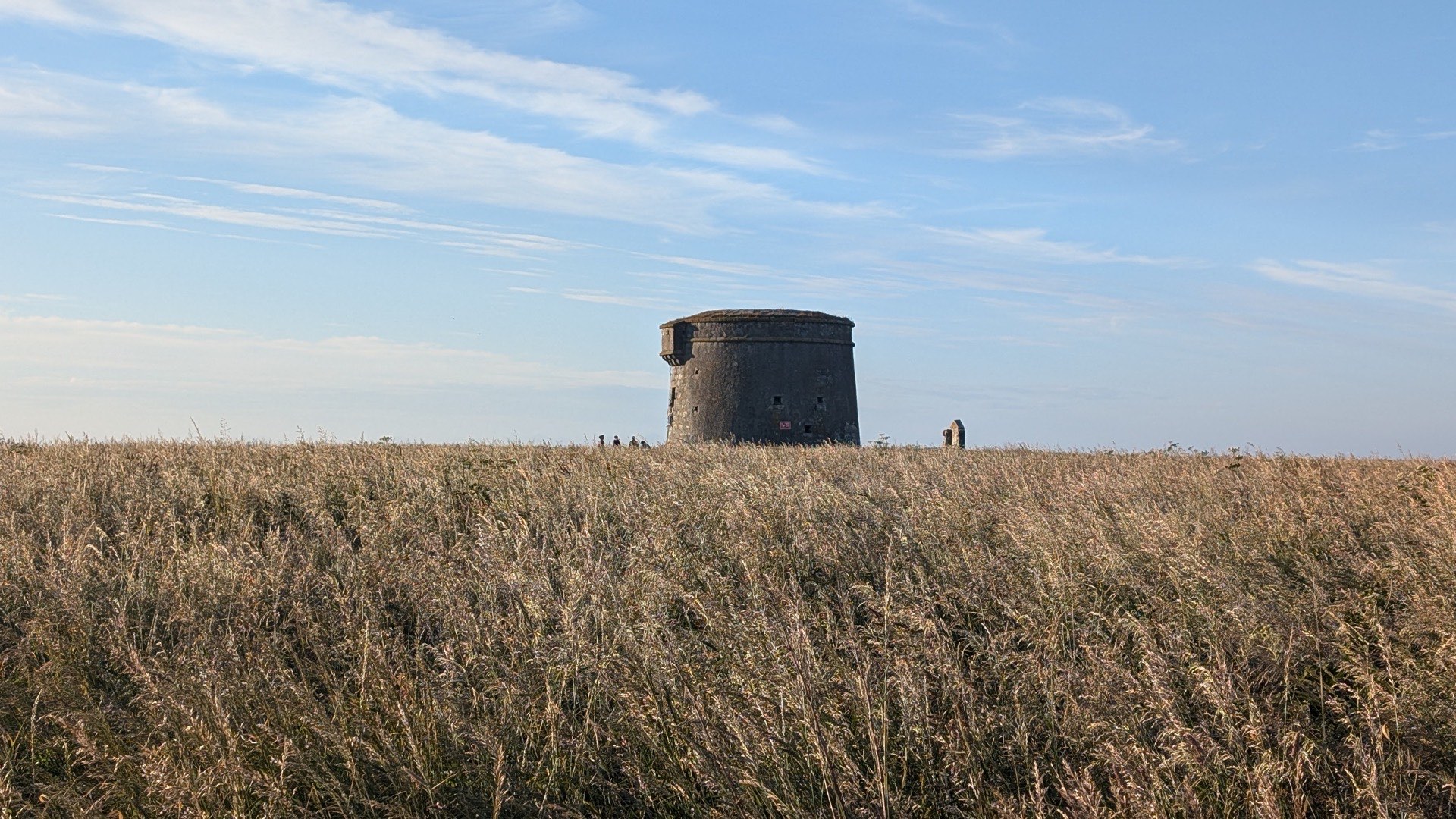
In 1803 the Martello tower was built on Drumanagh headland. It was one of a series built on headlands and islands on each side of Dublin to defend the city against Napoleon, but it was never used.
The seaweed war
In the 19th century, when the lands at Loughshinny belonged to Lord Holmpatrick of Skerries, what became known as the seaweed war broke out between the farmers of Rush and the landlord. The Rush farmers claimed free access to the foreshore at Skerries and Loughshinny to gather seaweed, which they used extensively to fertilise their crops. The landlord built a wall across the foreshore opposite Shenick Island in Skerries, and the Rush men pulled it down.
The case went to court and dragged on for 20 years. The landlord eventually won and imposed a levy of one shilling for every load of seaweed. This was very hard to collect, as the farmers avoided paying any way they could. The landlord’s men used to lie in wait for farmers with their horses and carts loaded with seaweed as they came slowly up the steep Curkeen hill. The farmers then took to gathering seaweed from Loughshinny strand, which was much harder for the landlord to patrol.
Harry Hawker’s seaplane
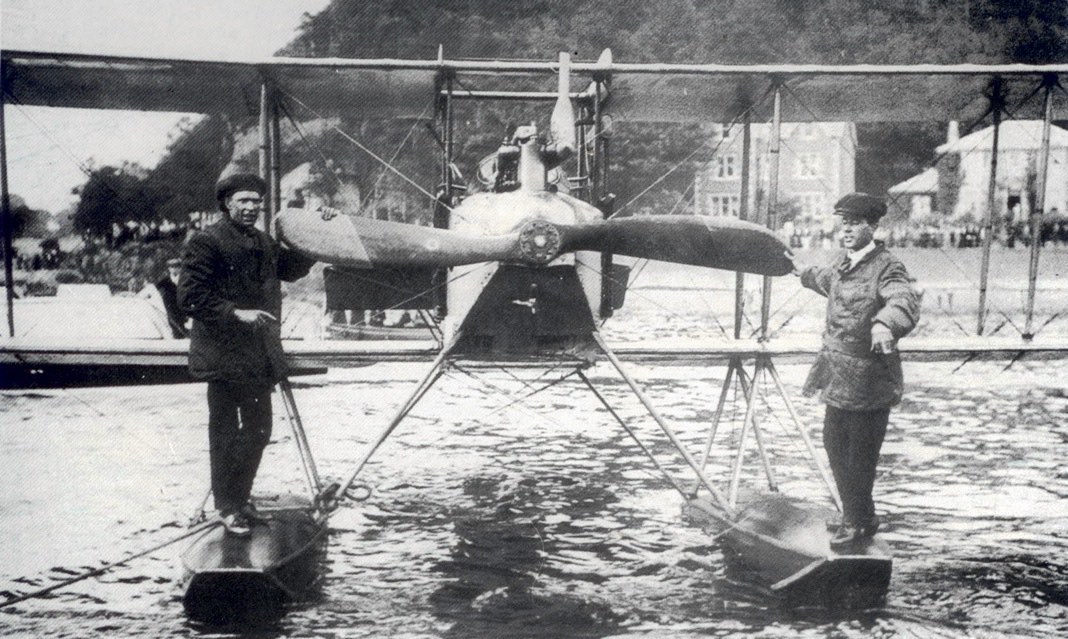
In 1913 the Daily Mail sponsored a great air race around the British Isles. One contestant, the Australian Harry Hawker, had completed three-quarters of the journey when a leaking fuel pipe brought his seaplane down in the middle of Loughshinny bay. He and his co-pilot were rescued by local fishermen, who also stripped the plane for souvenirs.
In more recent times another fuel pipe features in the story of Loughshinny: the North Sea gas interconnector pipeline comes ashore just south of Drumanagh headland. This major engineering project, funded by the European Union, was completed in 1995.
Loughshinny today
Nowadays Loughshinny is a peaceful place with a vibrant local community. The Community Association, elected each year to represent the village, is at the hub of activities and keeps a watchful eye on public works and developments for the benefit of the whole community. There are sea scouts, sports clubs and recreational groups to suit young and old.
Since 1994 the village has been officially twinned with the French village of Quistinic in Morbihan, Brittany. Exchanges take place every year between school groups, clubs and interested people in both communities, and festivals and cultural events are attended in both villages. The old De La Hayde coat of arms was revived and adopted as the symbol of Loughshinny for twinning purposes.
Fishing for crabs and lobsters is still a big part of the local economy, while the fertile farmland around the village still supplies vegetables and flowers to the Dublin market. Apart from some new housing and a new school, the village has not changed much over the years. It still keeps its old-world charm, within a stone’s throw of Dublin city.